
Cognitive Training for Team Sports
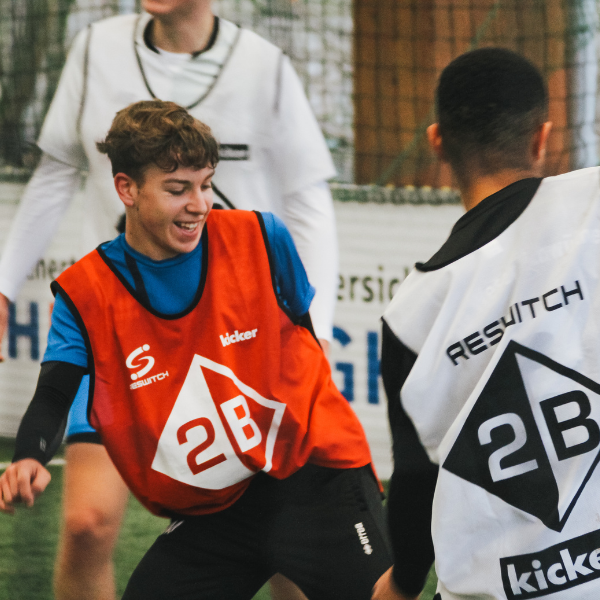
In all major team sports today—whether football, basketball, ice hockey, or handball—the pace of play has increased dramatically in recent years. Players have less and less time and space to make the right decision. Sports science research shows that up to 80% of relevant perceptual information is processed through the visual system. Those who see, anticipate, and act faster therefore gain a decisive advantage. This is exactly where RESWITCH comes in: color-, number-, and symbol-coded bibs simulate complex game situations, bringing the decision-making pressure of competition into training.
In football, the average time on the ball has fallen from 2.9 seconds in 2006 to just 1.1 seconds in 2020. Central midfielders in particular must scan, recognize an opponent behind them, and immediately decide whether to retain possession, pass the ball on, or attempt a vertical pass—all within this extremely narrow window. One second too late, and possession is lost. With RESWITCH, players learn to process visual stimuli more quickly and make the right choice under pressure, reducing misplaced passes and improving their speed of action.
These developments can also be clearly measured in basketball. The average possession duration in the NBA fell from 15.7 seconds (2003/04) to 14.4 seconds (2023/24), while the number of possessions rose from 90 to almost 100 per game. Stars such as Nikola Jokić hold the ball for an average of just 2.1 seconds, compared with 5.6 seconds for Luka Dončić and as much as 6.4 seconds per touch for Jalen Brunson. At the same time, studies show that basketball players under pressure use more efficient visual search strategies: fewer fixations overall, but more targeted fixations and more saccades. RESWITCH trains these very skills by requiring players to filter visual information in a split second and turn decisions into action immediately.
The demands are even more extreme in ice hockey. Players rotate in shifts of just 30 to 80 seconds, sprint at over 40 km/h, and must control a puck traveling at speeds exceeding 160 km/h. Goalkeepers have less than half a second to react to shots. Studies show that elite ice hockey players experience what are known as dual-task costs, because they must constantly process motor and cognitive tasks in parallel. A defender who has to decide within two seconds whether to clear the puck or pass to a teammate in their own defensive zone is under enormous pressure. RESWITCH simulates situations like these, helping players learn to make the right decisions even at maximum speed.
In handball, the constant switch between attack and defense defines the game. Players cover around 4 to 6 kilometers over two 30-minute halves, interrupted by hundreds of sprints, jumps, and physical challenges. Shots can reach speeds of up to 115 km/h—goalkeepers have less than 0.5 seconds to react. A study involving 50 players in different positions showed that goalkeepers need especially high levels of selective attention and reaction speed, while playmakers use working memory to identify gaps in defense. Wing players, meanwhile, react to passing opportunities that may remain open for only 0.2 to 0.3 seconds. More recent research into stroboscopic training shows that visual processing speed in handball can be significantly improved. RESWITCH brings this decision-making pressure into training: players learn to recognize colors and symbols under physical load and immediately choose the correct action.
Whether in football, basketball, ice hockey, or handball, fractions of a second now determine success or failure. RESWITCH integrates cognitive training directly into team training. Players improve their peripheral vision, process information faster, and make more accurate decisions under pressure. This gives RESWITCH teams a decisive advantage when it matters most.
References
General (visual perception in sport)
-
IOC Consensus Statement: Eye Health and Sport – ‘nearly 80% of perceptual input is visual’
Source: PMC10357794 -
Ballet et al. (2023): Research on visual perception evidenced that 80 % of the information … is taken through the eyes
Source: PMC10704066
Football
-
RESWITCH official website – product description, time on the ball (2.9 s → 1.1 s)
Source: reswitchtraining.com reswitchtraining.com -
Jordet, G. & Roca, A. – Research on scanning and decision-making quality (widely cited in sports science, 2011–2017).
Basketball
-
PMC: The impact of time pressure on decision-making and visual search characteristics in basketball players
Source: PMC9111422 pmc.ncbi.nlm.nih.gov -
Blaze Radio: With Scoring Higher Than Ever, NBA Offense is Being Solved – Trends in possession length and pace
Source: Blaze Radio article blazeradioonline.com -
TalkBasket: Which players have the most touches per game? Luka Doncic leads the way – Seconds per touch
Source: TalkBasket talkbasket.net -
GiveMeSport: Denver Nuggets' Starting Five is a Well-Oiled Machine – 2024 playoff figures
Source: GiveMeSport givemesport.com
Ice hockey
-
PMC: Dual-task costs in speed tasks: a comparison between elite ice hockey, open-skill and closed-skill sports athletes
Source: PMC11284104 pmc.ncbi.nlm.nih.gov -
Specialty Vision: Visual Skills in Ice Hockey: Essential for Performance
Source: Specialty Vision article specialty.vision -
NHL/IIHF data: Official puck speed measurements (e.g., Zdeno Chára, 175 km/h).
Handball
-
PMC: Individual and Team Performance in Team-Handball: A Review
Source: PMC6946670 pmc.ncbi.nlm.nih.gov -
PMC: Cognitive Factors in Elite Handball: Do Players’ Positions Determine Their Cognitive Processes?
Source: PMC10357564 pmc.ncbi.nlm.nih.govpmc.ncbi.nlm.nih.gov -
PMC: Electrophysiological Evidence of Stroboscopic Training in Elite Handball Players
Source: PMC9321101


